


The theater, Federico Garcia Lorca said, is a public tribunal in which mankind ”submits as evidence old or mistaken lessons and explains with living examples the eternal norms of the heart and of human sentiment.” All over Latin America in recent years, the heirs of the great Spanish playwright and poet have been busy applying his dictum, and it is that spirit that animates the works they bring to the monthlong 12th Festival Latino in New York, which begins this week.
Four notable productions, from Mexico, Argentina, Costa Rica and Cuba, are on the playbill for 1988, and while each of the companies featured may scarcely be aware of the existence of the others, all have at least one thing in common: a desire to address the gamut of political and social problems that afflict Latin America. These are works born of upheaval, concerned with poverty, exile, repression, assassination, racism and revolution, in which authors function as prosecutors, actors bear witness to certain moral truths, and the audience is called upon to become a sort of jury.
”Mine is not a theater of spectacle or entertainment,” said the Mexican dramatist Jesus Gonzalez Davila, in a recent interview here. ”I feel content if someone is scandalized or offended by what I show on the stage.” Mr. Gonzalez Davila is the author of ”De La Calle” (”From The Street”), the tale of an abandoned child’s odyssey through the most brutal and sordid sections of Mexico City in search of his father.
”When people leave, I want them to get in their cars and, after they stop at the first red light, to really look for the first time at the kids who approach them hoping to sell gum or wash the windshield,” he continued.”I want them to see the hunger in those pinched faces and the grime under those fingernails.”
In ”The Pastor’s Martyrdom” by Samuel Rovinski, the story line has been taken from yesterday’s headlines. Mr. Rovinski, a Costa Rican, has based his play on the assassination in 1980 of Archbishop Oscar Arnulfo Romero of El Salvador. Outraged by the murder of a fellow priest and close friend, Archbishop Romero is ”forced to take positions in the face of history,” Mr. Rovinski said, and is transformed by the suffering and oppression he encounters into an outspoken defender of human rights, ”the modern equivalent of one of the prophets of ancient Israel.” In the play, as in real life, the bishop is assassinated as he celebrates Mass.
”The Pastor’s Martyrdom” is divided into six sections, ”in order to mimic the rhythm and cadences of the Mass,” said the director Alfredo Catania, a native of Argentina who has lived in Costa Rica for the last 12 years. In the intervals between scenes, he and Mr. Rovinski have inserted video excerpts from key events from the recent history of El Salvador and the last three years of the life of Archbishop Romero, with the noise of helicopters and machine guns as their soundtrack.
”When he was killed, we all hoped for a judgment, but that never happened,” said Mr. Rovinski, an engineer with various novels, plays, short stories and screenplays to his credit. ”That made me indignant, and I began to investigate and to talk to the people who had been directly involved with him. What I have ended up with here is a sort of history lesson, reflecting a very large problem in a very small country.”
That all four of the plays deal with human rights in one form or another is more by accident than design, the festival’s organizers said. ”We were not specifically looking for a unifying theme, because that is impossible,” said Joseph Papp, the producer, who joined co-directors Oscar Ciccone and Cecilia Vega in searching for and choosing the works to be presented. ”We are looking for the best show. Sometimes you find that the unifying theme is political, because certain issues are constants in Latin America.”
In selecting what Latin American works New York audiences will see, Mr. Papp said, the particulars of the politics matter less than the way they are presented. ”It must be well done – a work executed with some skill and worthy of being done here,” he said when asked what criteria had been used to pick the four plays. ”But it must also articulate a point of view, and a strong one. We gain from understanding what people are saying in these various countries.”
Mr. Gonzalez Davila’s play, which won virtually every major theater award here in 1987, is being staged by the Theater Company of the National Institute of Fine Arts and is directed by Julio Castillo, who says ”I know this world because I myself come from it, having spent my childhood on the margins of society.” It opens Wednesday, the same day as a Cuban production of Athol Fugard’s ”The Island,” and will be succeeded by ”Made in Lanus” (Aug. 7-13), in which an Argentine couple living in exile in the United States go home to visit relatives in a Buenos Aires suburb, and ”The Pastor’s Martyrdom” (Aug. 13-21).
Also on the festival’s theater program is ”Bang Bang Blues” (Aug. 23-27), a work in progress by Charles Gomez, a former CBS News correspondent based in Central America, that addresses, in satirical fashion, the way American television has covered – or failed to cover -the war in Nicaragua. Finally, from Spain comes ”Mariameneo, Mariameneo” (Aug. 14-21), a meditation on memory and conscience set in a poor and backward corner of Andalusia. All except Mr. Gomez’s play, which is in English, will have simultaneous translations at approximately half of the performances.
In addition, the Festival Latino will be offering its usual smorgasbord of Latin American film, television and music. A ”Tribute to Argentine Cinema” and a retrospective of the work of the exiled Chilean director Miguel Littin are planned, other films from Chile, Colombia, Cuba, Curacao, Mexico, Puerto Rico, Spain and the United States will also be shown, and the annual ”Concert for Peace and Friendship” will feature Tania Libertad of Peru and Inti-Illimani of Chile. For the first time ever, the festival has a corporate sponsor this year: Philip Morris is contributing $125,000 toward total expenses amounting to just over $1 million.
The drama of the Latin American street urchin is one that has been treated before, most notably in films, such as Luis Bunuel’s ”Los Olvidados” and Hector Babenco’s ”Pixote.” But Mr. Gonzalez Davila, who has taught drama in state orphanages and reformatories, is of the opinion that the world of today’s street children is harsher and more violent than ever and that the theme needs updating. ”Fifteen years ago, they used to send around trucks to pick the abandoned kids up off the streets and disinfect them,” he said. ”Nowadays, the kids are likely to gang up on the drivers, steal the truck, and dismantle and sell the parts.”
”From The Street” is a snapshot of a Mexico wracked by crisis, a portrait of one child ”behind whom lies the tragedy of an entire city,” as Mr. Gonzalez Davila puts it. Young Rufino, played by teen-ager Roberto Sosa Martinez, and his friend El Cero have no home and no school other than the street, and no aspirations beyond survival. ”Pay attention, I’m going to tell you what your problem is and how to resolve it,” a petty criminal named Trueno, or Thunder, tells Rufino. ”In these times, there is no money, no work, no nothing.”
If ”From the Street” addresses an issue Latin Americans are forced to confront daily, then ”Made in Lanus” is an attempt to come to terms with a problem that may be even more familiar, that of exile and the dread that arises from being uprooted – a phenomenon with which Argentines in particular have had ample experience. ”I first wrote this play some 25 years ago, but it died in the drawer,” said Nelly Fernandez Tiscornia. ”To make it apply to today’s situation all I needed to do was come up with a few new anecdotes, because history unfortunately repeats itself in Argentina.”
Grounded in that reality, ”Made in Lanus” examines the reactions of four characters to the questions raised by exile. Osvaldo, a doctor, and his wife Mabel ”turned tail and ran when the threats began,” they admit, and now lead a comfortable life in the United States. But when democracy returns, they return to visit her brother, Negro, and his wife, Yoly, impelled by memories and a desire to recover their identity. ”I am seeking my own scent,” Osvaldo says at one point. ”Here I left behind so many things that could not fit into a suitcase.”
Negro wants to join his sister in the United States, but Yoly seems to be speaking for Ms. Fernandez when she says she believes in a better future, ”but here,” and refuses to go.
”I have three children and a grandchild, and I fervently hope that the experiences we lived through will never return,” Ms. Fernandez said. ”I also believe that it is necessary for all Argentines, not just the government, to assume responsibility so that it never happens again. My play is both a warning and an expression of my conviction that we have to continue to struggle and to commit ourselves wholeheartedly to democracy in our country.”
Of the four plays being presented, only the Cuban production is not an original work. The original version of ”The Island” was set in a South African prison, where two black cellmates are about to stage ”Antigone” for their fellow prisoners. But Filander Funes, a Salvadoran director who studied theater in the Soviet Union and now lives in exile in Havana, has made several changes to give the play more of a Latin American flavor – adding original music, for example, to imply the presence of a malevolent jailer just offstage.
But the most important transformation came from Mr. Funes’s decision to make one of the cellmates white and the other black. His objective, he said in a telephone interview from Havana, was to ”show that both men are discriminated against and undervalued by different forms of segregation, and to show that each is capable of defending the rights of his brother of another color.”
Race is a problem in Cuba, but the play can also be seen as operating on another, more overtly ideological, level. ”The fact that it is the Cubans who are doing a Fugard play is itself very significant to me,” Mr. Papp said. ”They have problems in Cuba that have to do with human rights, and those are far from having been dealt with. I like the contradiction there, and the juxtaposition with South Africa is interesting.”
Just to reach New York, each of the four plays has had to overcome numerous obstacles. To a large extent, Latin American playwrights and actors perform in a near vacuum. Economic constraints mean that even if a production like ”From The Street,” with more than 23 actors, or ”The Pastor’s Martyrdom,” which had a cast of 43 when performed in San Jose but has been reduced to 18 for New York, can be mounted, it is not likely to tour outside its own country. As a result, a truly Latin American theater has yet to develop.
”In April, I went to a conference in Bogota, and we all had to introduce ourselves to each other,” Mr. Gonzalez Davila said. ”Everybody had to stand up and say he’d done this or that, because nobody knew the others’ work. There are still no channels for that kind of interchange or awareness.”
That situation contrasts sharply with the status of the Latin American novel, which in the last 25 years has taken wing and become a major world force. Readers in Peru, for example, are very much aware of novelists emerging in Mexico or Venezuela or Argentina. Mr. Rovinski argues that ”the dramatic talent is there,” but because the theater is a ”collaborative and collective art,” rather than a solitary creation, dramatists are at the mercy of others.
”The novelists are 100 years ahead of us,” Mr. Catania agreed. ”You don’t even have to mention countries as distinct as Mexico and Argentina. There is a total separation even among those of us who live in an area as small and as closely linked as Central America. It’s a shame, and we have ourselves to blame for it.”
Playwrights and actors intent on developing a theater with truly national characteristics must also contend with competition from abroad. The distinction between commercial and experimental theater may be even more marked in Latin America than in the United States or Europe, and producers here often find it easier to stage a play by Neil Simon, Alan Ayckbourn or Woody Allen, whose success has already been demonstrated elsewhere, than to take a chance on local talent.
In fact, Latin America directors and actors who choose to work exclusively with material produced in, and reflecting the reality of, their own countries continue to be regarded as rather odd. ”I’ve been working only with Argentine playwrights since 1971, because it seems to me that I am most useful in that manner,” said Luis Brandoni, who plays Oswaldo in ”Made in Lanus.” ”I know Argentine characters and their problems, language and personalities more profoundly than I do those of other countries. But reporters are always asking me why I do what I do.
”Would that question be asked of an actor in the United States?” Mr. Brandoni, a former president of the Argentine actors’ union who spent several years in exile in Mexico, wondered. ”I think not. There, what I am doing would be regarded as perfectly natural.” ANOTHER COUNTRY HEARD FROM
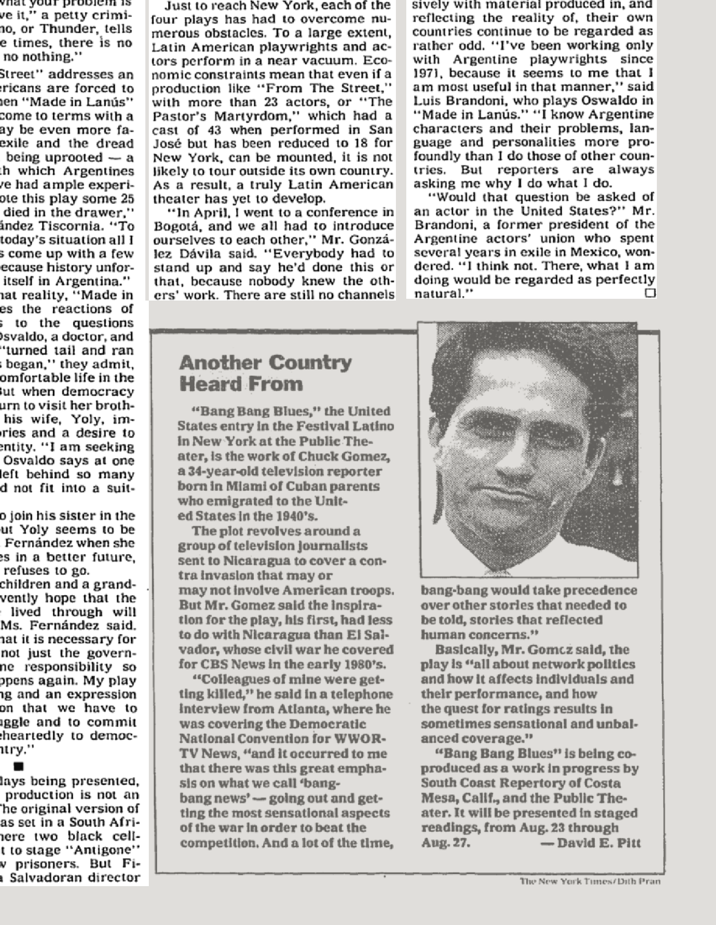
”Bang Bang Blues,” the United States entry in the Festival Latino in New York at the Public Theater, is the work of Chuck Gomez, a 34-year-old television reporter born in Miami of Cuban parents who emigrated to the United States in the 1940’s.
The plot revolves around a group of television journalists sent to Nicaragua to cover a contra invasion that may or may not involve American troops. But Mr. Gomez said the inspiration for the play, his first, had less to do with Nicaragua than El Salvador, whose civil war he covered for CBS News in the early 1980’s.
”Colleagues of mine were getting killed,” he said in a telephone interview from Atlanta, where he was covering the Democratic National Convention for WWOR-TV News, ”and it occurred to me that there was this great emphasis on what we call ‘bang-bang news’ – going out and getting the most sensational aspects of the war in order to beat the competition. And a lot of the time, bang-bang would take precedence over other stories that needed to be told, stories that reflected human concerns.”
Basically, Mr. Gomez said, the play is ”all about network politics and how it affects individuals and their performance, and how the quest for ratings results in sometimes sensational and unbalanced coverage.” ”Bang Bang Blues” is being co-produced as a work in progress by South Coast Repertory of Costa Mesa, Calif., and the Public Theater. It will be presented in staged readings, from Aug. 23 through Aug. 27. David E. Pitt